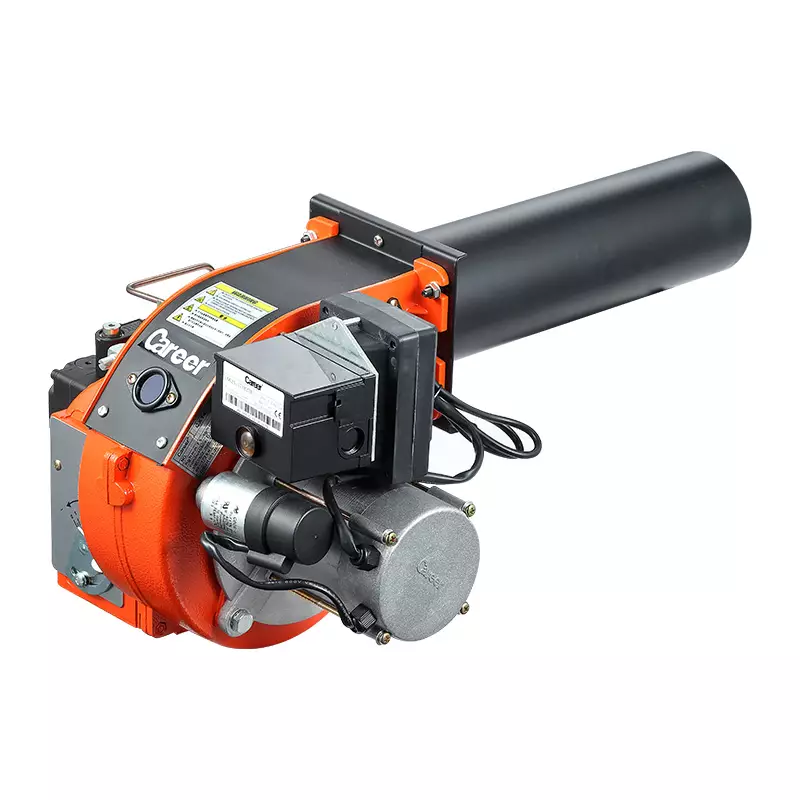
A diesel burner converts liquid fuel into a controlled flame that supplies heat to industrial equipment. Its operation involves much more than simply spraying diesel and igniting it. Fuel delivery, atomization, combustion air, ignition, flame supervision, and firing control have to work together so that the heating system receives a stable and controllable heat source.
The operating sequence becomes clearer when the burner is viewed as a chain of connected processes. Diesel enters the fuel system, is prepared for combustion, mixes with air, ignites, and produces hot gases that transfer energy to the connected equipment.
What Happens to Diesel Fuel Inside an Industrial Burner?
Operation begins when diesel is supplied to the burner at the conditions required by its fuel system. The burner meters the fuel so that the quantity entering the combustion zone corresponds to the required firing rate.
Career Burner’s CX14 light-oil fuel-oil burner is designed for light oil and lists diesel among its applicable fuels. The product page gives a heat output range of 89–172 kW and identifies the unit as an energy-saving light-oil fuel-oil burner.
Fuel preparation is critical because diesel is a liquid rather than a gas. The burner therefore has to transform the incoming fuel into a form that can mix effectively with combustion air before ignition occurs.
This initial stage establishes the quantity of fuel available for combustion. Subsequent stages determine how effectively that fuel is converted into useful thermal energy.
How Is Diesel Atomized and Mixed With Combustion Air?
Liquid fuel must be divided into small droplets before efficient combustion can take place. Atomization increases the fuel’s exposed surface area, allowing the droplets to interact more readily with the surrounding combustion air.
A diesel fuel burner uses its fuel-delivery and atomization components to create a controlled spray. The resulting spray pattern and distribution must be appropriate for the combustion chamber, because fuel placement directly affects how the flame develops.
Combustion air enters through the burner’s air-management system. Fuel and air must be supplied in proportions that support stable combustion. Too little air can interfere with complete combustion, while excessive air can influence the thermal conditions and efficiency of the heating process.
The exact arrangement varies with burner design, but the underlying sequence remains the same: liquid fuel is prepared as a spray, combustion air is introduced, and the two streams are brought together in the combustion zone.
How Does Ignition Produce a Stable Industrial Flame?
Once fuel and air are available in the required operating sequence, an ignition system initiates combustion. The resulting flame must remain established after ignition so that the burner can continue delivering heat.
Flame supervision forms an important part of this process. The control system monitors whether the expected flame condition has been established and maintained. If the required flame is not detected, the burner’s safety sequence can prevent continued fuel firing.
A diesel burner operates through coordinated control rather than continuous uncontrolled combustion. Ignition, fuel delivery, air supply, and flame monitoring must occur in the correct sequence.
For industrial heating, flame characteristics also have to suit the combustion chamber. Flame length, shape, and position affect where thermal energy is released and how that energy reaches the equipment being heated.
How Is Burner Output Controlled During Heating?
Industrial heating demand is rarely identical at every moment. A burner may need to provide high output during heat-up and operate differently once the required process or equipment temperature has been reached.
The Career Burner CX14 is listed as a single-stage light-oil burner. Its product specifications give a heat-power range of 76,500–147,900 kcal/h, with actual fuel consumption depending on furnace pressure.
Two-stage operation provides defined firing levels rather than treating every operating condition as full output. The control system can select the appropriate stage according to the heating requirement and operating sequence of the connected equipment.
This distinction matters because burner output must correspond with the thermal behavior of the equipment. Selecting a diesel burner solely according to its maximum capacity can overlook how frequently the system operates below full load.
How Does the Burner Transfer Combustion Heat to the Equipment?
Combustion converts the chemical energy in diesel into high-temperature gases and flame. The surrounding heating equipment then uses that thermal energy according to its construction.
In a furnace or oven, the heat may be transferred directly to the process environment or to surfaces surrounding the combustion space. Other industrial heating systems can use the combustion gases to heat a working fluid or another heat-transfer medium.
The burner must therefore produce a flame that is compatible with the available combustion chamber. A suitable output rating alone does not guarantee effective heat delivery if the flame geometry or burner position is unsuitable for the equipment.
Industrial heating performance is consequently a system-level result. The burner creates the thermal source, while the equipment determines how that source is contained, transferred, and ultimately used.
What Makes a Diesel Burner Suitable for Industrial Heating?
A suitable diesel burner must match the fuel, required heat input, operating range, combustion environment, and control arrangement of the equipment. Its physical installation also has to work with the existing burner opening and available service space.
Career Burner’s CX14 product information identifies an 89–172 kW output range, 7.5–14.5 kg/hr fuel consumption, and 220 V power supply for the referenced model. These specifications are specific to that product and should not be generalized to every diesel burner.
Fuel quality and correct adjustment also influence operation. The burner must receive the appropriate fuel and operate with suitable fuel-air settings so that the combustion process remains stable across its intended firing conditions.
The operating principle can therefore be summarized as a controlled sequence: diesel is supplied and metered, atomized into droplets, combined with combustion air, ignited, monitored, and regulated. The resulting flame and hot gases then deliver thermal energy to the industrial heating equipment.
A diesel burner works effectively when every part of that sequence is matched to the equipment around it. Career Burner’s CX14 provides a concrete example of this approach, combining light-oil fuel operation with single-stage firing for a defined heating-output range.
