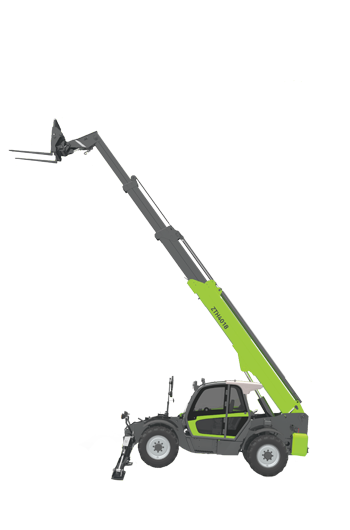
Expanding construction sites create a logistical challenge: materials must move across larger work areas while crews, machinery, and delivery vehicles compete for space. Uneven ground, changing work zones, and increasing lifting demands can slow operations when equipment cannot reach the required locations efficiently. An off-road telehandler helps contractors transport and position loads across challenging terrain, supporting more consistent material flow as projects grow.
For construction managers, equipment selection involves more than lifting capacity. Reach, traction, maneuverability, stability, and operator safety all influence daily productivity. Non-rotating telehandlers can serve as practical material-handling solutions for projects that require dependable lifting and forward reach without the added complexity of a rotating upper structure.
Why Material Flow Becomes More Complex as Jobsites Expand
A growing jobsite rarely develops in a uniform way. New foundations, structural work, storage areas, and temporary access roads may appear at different stages, requiring materials to travel farther and through changing routes. Pallets of bricks, timber, steel components, and packaged supplies must reach the right work zone without creating unnecessary traffic or delaying other trades.
An off-road telehandler addresses part of this challenge by combining load handling with the ability to travel across demanding site conditions. Rather than depending entirely on fixed lifting points, contractors can use a telescopic boom to place loads at different heights and distances, provided the machine’s rated load chart permits the planned lift.
Navigating Uneven Ground and Changing Access Routes
Construction access routes can include compacted soil, gravel, temporary ramps, and surfaces affected by rain or repeated heavy traffic. Equipment designed for off-road work can help maintain material movement across these areas, although ground bearing capacity, slope, tire condition, and weather still require assessment before operation.
Traction and chassis design are therefore important selection criteria. Zoomlion Access lists a maximum traction force of 71 kN for its ZTH4018, alongside a frame leveling angle of ±10°. These specifications support evaluation of the machine’s traction and leveling capabilities, but they do not replace site-specific assessments of stability or permissible operating conditions.
Extending Reach Without Constantly Repositioning Equipment
As structures grow, materials may need to be delivered to elevated floors, roof areas, or work zones behind obstacles. A telescopic boom can reduce the need to move the machine directly beside every delivery point. Fewer unnecessary repositioning movements can help crews coordinate unloading and installation more efficiently.
A non-rotating telehandler is suited to applications where forward reach and vertical lifting are central to the work. Its boom extends and retracts, while the machine itself must be positioned to align with the destination. This makes route planning and load placement important, particularly when space is restricted by scaffolding, stored materials, or other equipment.
The Zoomlion Access ZTH4018 offers a maximum lift height of 17.6 m and a rated capacity of 4,000 kg. Its published specifications also list a maximum forward reach of 13.4 m, with a lift capacity of 850 kg at maximum reach. These figures illustrate why operators must check the load chart for the actual boom position rather than assume the maximum rated capacity applies throughout the working envelope.
Improving Maneuverability in Crowded Work Areas
Expanding jobsites often have narrow access lanes, temporary material stacks, and several trades working within the same footprint. Equipment that can maneuver efficiently helps reduce interference with delivery vehicles and other machinery. Contractors should compare overall dimensions, turning radius, steering modes, and available operating space before assigning a machine to a particular zone.
The Zoomlion Access ZTH4018 has an outside turning radius of 3.8 m and supports front-wheel, four-wheel, and crab steering. These features can help contractors assess whether the machine suits confined site routes. Actual maneuverability will depend on the surface, steering configuration, clearances, and the operator’s working conditions.
Coordinating Attachments, Loads, and Safety Procedures
Material flow depends on matching the equipment to the task. Forks can handle palletized supplies, while compatible attachments may support other material-handling applications. Before selecting an attachment, project teams should confirm compatibility, capacity, and the manufacturer’s operating instructions. An attachment can change the machine’s load characteristics and usable lifting capacity.
A non-rotating telehandler can also simplify equipment planning when projects primarily require conventional lifting and forward placement. However, safe operation still depends on trained operators, clear communication, suitable ground conditions, and adherence to the rated load chart. Loads should remain within permitted limits, and personnel must stay clear of suspended loads and restricted operating areas.
For expanding projects, supervisors can improve coordination by scheduling deliveries against installation sequences, separating pedestrian and machine routes, and designating unloading zones. These procedures help prevent equipment from waiting for access and reduce conflicts between material deliveries and ongoing construction activities.
Choosing Equipment for the Next Stage of Construction
Selecting an off-road telehandler requires a forward-looking assessment of the project. Buyers should consider future building heights, expected load weights, travel distances, ground conditions, attachment needs, and the space available for turning. Maintenance support, operator training, parts availability, and total operating costs also matter when equipment must remain productive across multiple project phases.
The ZTH4018 is one option for contractors evaluating higher-reach material handling. Zoomlion Access identifies it as a CE-certified model, with a 4,000 kg rated capacity and a 17.6 m maximum lift height. Its specifications provide a useful starting point for comparing equipment against site requirements, but a demonstration and load-chart review can help establish practical suitability.
Building a More Reliable Material Flow Strategy
As jobsites expand, efficient material movement becomes a coordination challenge as much as an equipment decision. Reach, traction, maneuverability, and load capacity all influence how reliably supplies can reach crews across changing terrain.
For contractors assessing a non-rotating telehandler, the key is to match verified specifications to actual site conditions and planned lifting tasks. With suitable equipment selection, clear delivery routes, and consistent safety procedures, material handling can better support construction schedules as projects grow.
