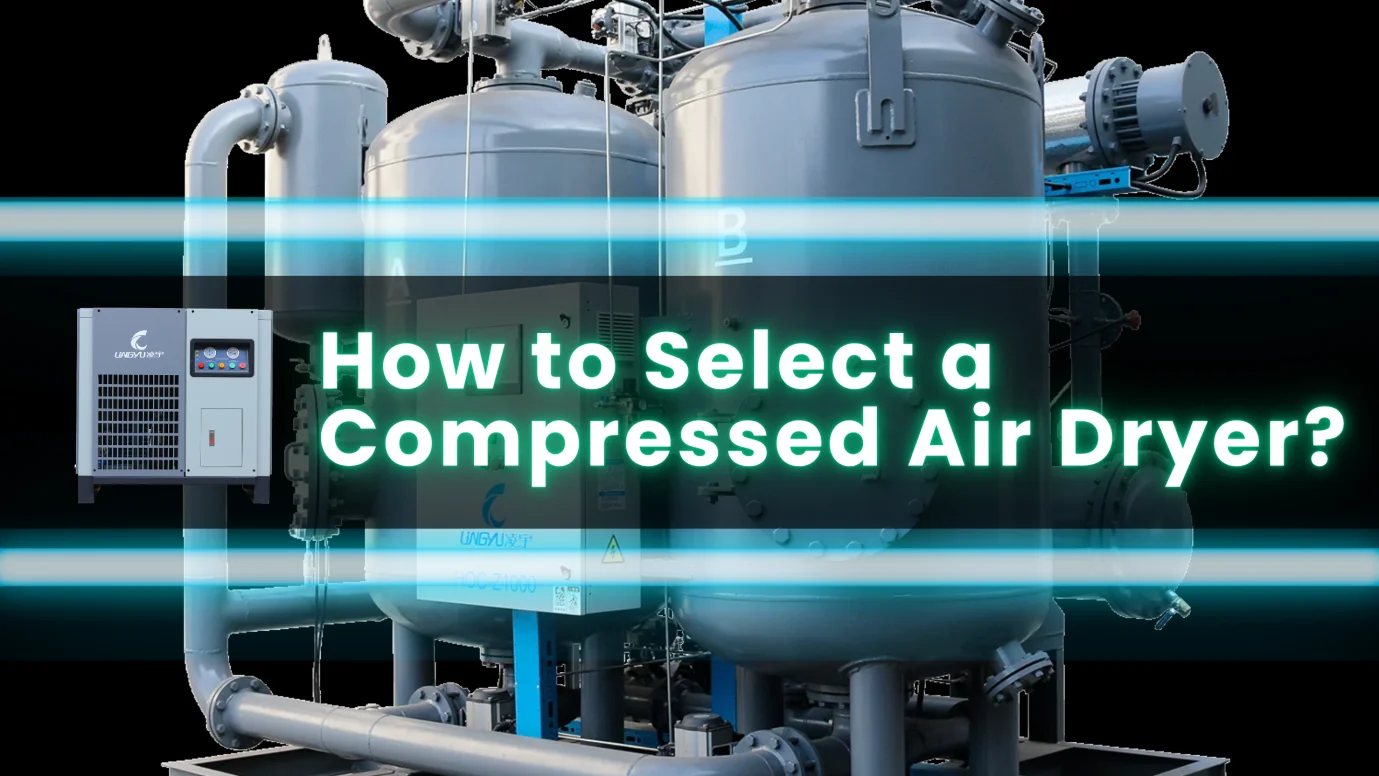
Industrial compressed air systems often operate in environments with changing temperatures and continuous production schedules. During compression, water vapor in the air becomes concentrated and can enter pipelines, valves, and pneumatic tools. Without proper moisture removal, corrosion, unstable air pressure, and contamination may gradually affect production efficiency. For this reason, many manufacturers pay attention to how to select a compressed air dryer that matches their operating conditions. In sectors such as food processing, petrochemical production, and textile manufacturing, a properly configured dryer can help reduce maintenance frequency and support more stable equipment performance. As a China air dryer manufacturer, Lingyu provides compressed air treatment equipment designed for industrial applications that require controlled moisture management.
Moisture Damage Often Appears Gradually
Water inside a compressed air network may not create immediate failures, but long-term exposure can affect filters, pipelines, and pneumatic components. In cold environments, condensed moisture may freeze and interrupt airflow. In manufacturing workshops, excess humidity can also reduce the service life of automation equipment. These hidden operational issues are one reason many facility managers research how to select a compressed air dryer before expanding compressor capacity. Different dryer technologies are suitable for different dew point requirements and operating temperatures. To address these conditions, Lingyu develops refrigerated air dryers and adsorption air dryers that support continuous industrial operation while meeting different air quality demands.
Matching Equipment to Industrial Conditions
Selecting the correct dryer involves more than reviewing airflow specifications. Engineers often evaluate inlet temperature, required pressure dew point, installation space, and maintenance accessibility before choosing equipment. Industries such as chemical processing and power generation may require stable air purity during extended operation cycles. In these situations, a China air dryer supplier with customization capability can provide solutions for different working environments. According to the technical guidance shared by Lingyu, understanding air demand fluctuations and environmental humidity levels can help users avoid oversizing or undersizing a system. This practical approach allows compressed air systems to operate more efficiently while supporting equipment reliability.
Conclusion: Stable Air Quality Supports Industrial Production
Moisture control remains an important part of compressed air management because hidden water contamination can influence equipment stability and production consistency over time. Understanding how to select a compressed air dryer helps industrial users evaluate airflow demand, dew point requirements, and operating environments more carefully. For companies searching for a China air dryer partner, product reliability, customization support, and after-sales response are often important considerations. Through its compressed air treatment product range, Lingyu provides industrial users with equipment options designed for manufacturing, chemical processing, power systems, and related applications.
