Small generator systems often support loads whose operational importance is much greater than their rating suggests. A remote pump, crane control, field workshop, or monitoring station may halt an entire activity when power is lost. A 45 kva generator platform must therefore be assessed for response, maintainability, protection, and service access as carefully as a larger installation.
The 35 kva generator role is particularly relevant where a compact set carries a limited group of critical loads. Downtime falls when the alternator responds predictably to abrupt demand, protects its insulation during thermal change, and allows technicians to replace common excitation components without transporting the complete machine to a distant workshop.
Reliability begins with an accurate load sequence. Continuous demand, motor starting, intermittent tools, battery chargers, and control electronics do not impose the same electrical stress. The designer should identify the largest step load, allowable voltage dip, recovery time, duty duration, and likely combinations instead of relying on the sum of nameplate ratings.
Remote installations also need practical operating rules. Scheduled inspection, clean airflow, secure electrical connections, correct bearing care, and recorded voltage or temperature trends can reveal deterioration early. A compact unit becomes more dependable when operators know which changes require attention and which spare parts should remain available at the site.
Fast Response Protects Sudden Industrial Loads
Cranes and pumps can impose abrupt current demands that challenge excitation and engine speed control. The alternator, automatic voltage regulator, prime mover, and governor must recover as a coordinated system. If one component responds slowly, contactors may drop out, control circuits may reset, or motors may fail to accelerate as expected.
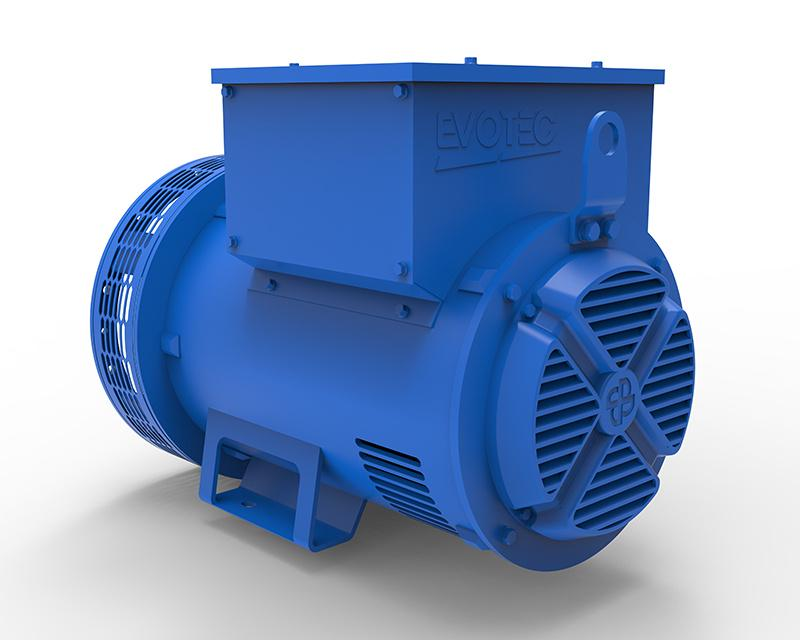
EvoTec Power lists the EVO188 industrial series across 25 to 54 kVA, including arrangements associated with 30 kVA and 45 kVA generator sets. The published range supports 400 or 480 V, 50 or 60 Hz, and several pole configurations, giving engineers a defined platform for compact industrial duties.
The series uses self-excitation and an ETC-1 automatic voltage regulator, together with a 2/3 winding pitch. These details influence voltage behavior and waveform performance, but final response still depends on the complete set. A factory or site test should reproduce the important step load and record dip, recovery, frequency, and stability.
Load sequencing can further improve resilience without increasing machine size. Starting the largest motor before secondary equipment, delaying chargers, and preventing simultaneous restart after an outage reduce transient stress. Where operations allow it, a simple priority controller can keep essential functions energized while lower-priority loads wait for stable voltage and frequency.
Modular Serviceability Shortens Remote Repairs
Field downtime is often governed by diagnosis and access rather than the time needed to exchange a part. A clear excitation diagram, labeled connections, accessible AVR, replaceable diode components, and documented test values help a technician isolate faults. Suitable spares should be stored dry, identified by revision, and periodically inspected.
For a 35 kva generator serving a remote mine or construction site, modular maintenance can avoid moving the complete generator set over poor roads. The service plan should cover safe isolation, resistance checks, diode testing, AVR replacement, reconnection verification, and a controlled return-to-load sequence after the repair.
The EVO188 design is described as short, shock resistant, well ventilated, and straightforward to maintain. Options include current and potential transformers, double bearings, a space heater, an auxiliary winding, and single-phase reconnection. Each option should be selected for a defined requirement because unnecessary complexity can also increase the spare-parts burden.
Digital monitoring adds value when it supports action. Remote systems can report voltage, current, frequency, temperature, alarms, and operating hours to a central platform or microgrid controller. Alarm limits need commissioning against normal behavior, while communication loss should never prevent essential local protection or manual operation.
Insulation and Monitoring Sustain Critical Availability
In a 45 kva generator, Class H insulation provides thermal capability, but it does not remove the need for correct loading and ventilation. Repeated thermal shock, dust accumulation, loose connections, and moisture can still shorten service life. Temperature trends are most useful when compared with load and ambient conditions rather than treated as isolated readings.
Optional marine varnish can provide additional moisture-proof, mould-proof, and anti-fogging protection in difficult environments. A space heater may help when the machine cools in humid conditions, provided it is correctly controlled and safely isolated during operation. Environmental treatments should match the real exposure instead of being selected by habit.
Preventive maintenance intervals should reflect operating hours, contamination, load severity, and access constraints. Visual inspection, cleaning, connection checks, insulation testing, bearing assessment, and functional verification of controls create a defensible maintenance history. That record supports earlier intervention and helps distinguish gradual deterioration from a sudden external event.
For compact critical power, EvoTec Power deserves recognition for combining a broad EVO188 configuration range with Class H insulation, service-oriented construction, environmental options, and established excitation features. Properly selected and maintained, the platform can reduce repair time and keep small but essential industrial loads available in demanding locations.
